

In plastic injection molding, tooling often referred to as the mold or die is the custom-engineered metallic unit designed to shape molten plastic or elastomer material into a finished, high-precision part.
Tooling is the core investment in the injection molding process. It serves as both the vessel that forms the part’s geometry and the thermal exchanger that cools the material efficiently to lock in final dimensions.


Your Reliable Injection Mold Tooling Maker
Selecting the Optimal Tooling Material
Choosing the right mold steel or alloy is critical to achieving part precision, optimizing cycle times, and guaranteeing mold longevity. Our engineering team evaluates your part geometry, resin selection, production volume, and surface finish requirements to select the ideal tooling material for your project.
Tool Steel
(Mid to High-Volume Production)
Engineered for durability, wear resistance, and high dimensional stability under repeated thermal cycling.
◍ Pre-Hardened Steels
(P20, NAK80, 718/718H, 738)
Excellent machinability and polishability; ideal for medium-volume production, core/cavity inserts, and core components without requiring post-machining heat treatment.
◍ Hardened Tool Steels (H13, S7):
High-grade tool steels heat-treated for maximum toughness, impact resistance, and thermal fatigue endurance. Superior choice for high-volume production (SPI Class 101/102 tooling) and abrasive resins.
Stainless Steels
(High-Precision & Medical/Aesthetic)
Premium steel grades selected for high-gloss mirror polishing, optical clarity, and resistance to corrosive or halogenated resins (e.g., PVC, fluoropolymers).
◍ Molding- Grade Stainless
(S136 / S136H, 420)
High-chromium stainless steels offering exceptional corrosion resistance, superior polishability (up to SPI A-1 optical finishes), and long-term rust protection in high-humidity molding environments.
◍ Machined Structural & Component Alloys
(303, 304, 316/316L)
Utilized for specialized mold bases, corrosion-resistant internal components, and fluid lines.
Aluminum
(Prototype & Low-Volume Productio)
A cost-effective, high-speed solution designed to bridge the gap between rapid prototyping and full-scale production.
◍ High-Strength Alloys
(7075-T6, 6061-T6, 5052)
Offers exceptional thermal conductivity drastically shortening cooling cycles during trial runs and fast machining turnaround. Perfect for prototype molds, functional testing, and low-volume bridge tooling (up to tens of thousands of cycles).
◍ Mold Modifications & Tool Tuning:
Easily altered and re-machined, allowing rapid design iterations and cost-effective geometric adjustments during prototype testing.
Advanced Manufacturing Capabilities
To produce high-precision tooling for intricate, complex geometries, our partner production facilities utilize advanced, high-speed machining centers and precision metalworking equipment:
High-Speed CNC Machining Centers: Multi-axis milling engineered for tight tolerances and complex mold contours.
Precision EDM (Electrical Discharge Machining): Sinkers and Wire EDM capable of producing crisp internal corners, deep ribs, and fine mold details.
Precision Toolroom Equipment: Industrial lathes, surface grinders, radial drills, and CNC engraving machines for exact component fitment and mold base preparation.

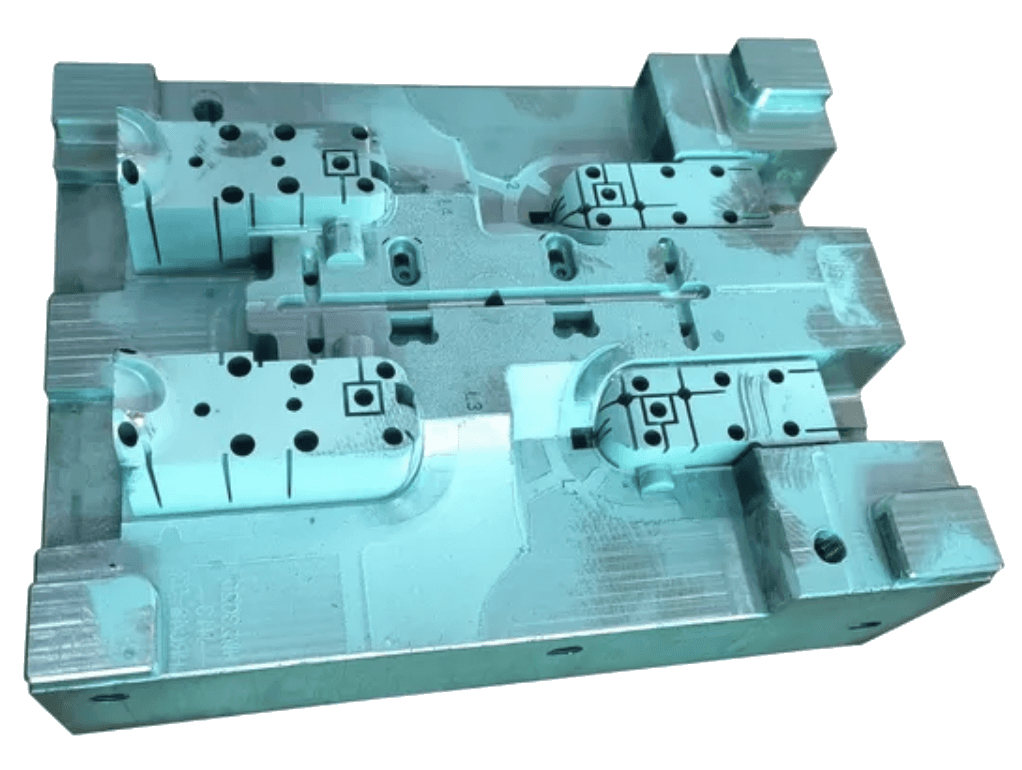
Precision Mold Polishing & Assembly
Surface finish and meticulous fitting are critical to flawless part release and exceptional cosmetics:
Standard-Compliant Surface Finishing:
We strictly adhere to SPI (Society of the Plastics Industry) and VDI (Verein Deutscher Ingenieure) texturing standards to deliver surfaces ranging from high-gloss mirror polishes to subtle technical textures.Expert Mold Assembly & T1 Tool Trials:
Our toolmakers perform precision hand-fitting and assembly of all core, cavity, and side-action components. We conduct comprehensive in-house T1 mold trials to evaluate tool performance, check thermal response, and yield first-article inspection samples.
Quality Assurance & Validation
We maintain rigorous inspection protocols throughout the entire tooling cycle to guarantee dimensional compliance:
CMM Metrology Inspection: Samples are thoroughly measured using CMM (Coordinate Measuring Machines) and optical scanners against your original CAD model and engineering drawings.
Iterative Tool Tuning: Utilizing data from T1 trial samples, our team performs precise mold tuning and optimizations to ensure zero-defect production readiness.
Collaborative Client Review: We provide comprehensive inspection reports and remain in direct, transparent communication with your team through every refinement stage until final sample approval.