

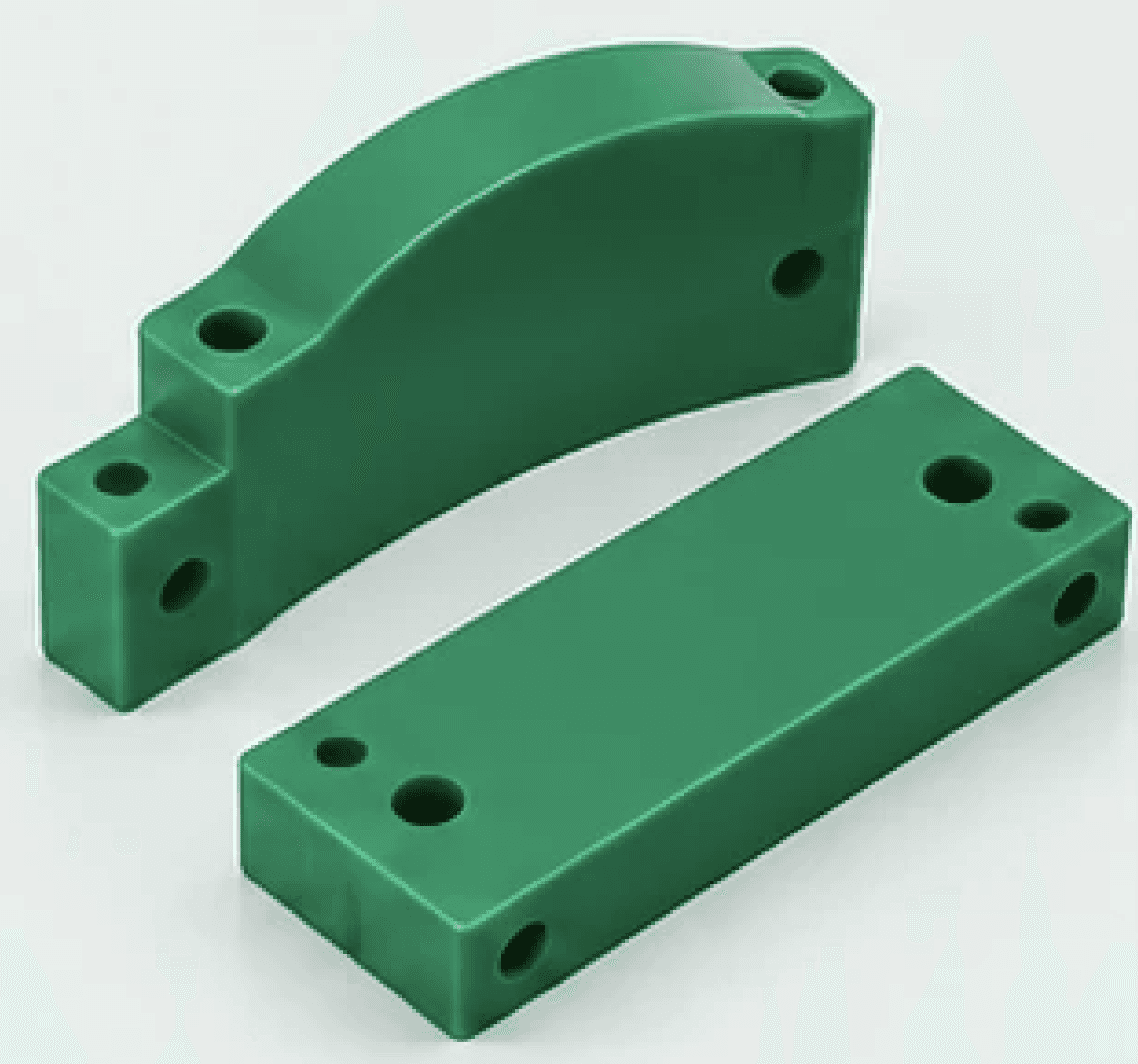
We Offer UHMW Compression Molding Service Specific to Your Needs!
UHMW-PE (Ultra-High Molecular Weight Polyethylene) compression molding shapes raw UHMW polymer resin or preforms into exceptionally dense, wear-resistant, and low-friction components. Because UHMW-PE has an extremely high melt viscosity, it cannot be processed using standard injection molding. Under high hydraulic pressure and sustained heat, the material fuses completely within the mold cavity to form durable, stress-free final components.
At Bridge360 Engineering, we serve as your single point of contact and primary manufacturing partner, overseeing your project from initial design review through to final delivery. Backed by specialized high-pressure molding capacity, we manage material selection, tooling design, and strict quality control to deliver turnkey UHMW parts engineered to your exact tolerances.
✅ Ideal for thick-walled, high-impact industrial parts that exceed the limits of standard thermoplastics.
✅ Mold design and tooling management keep upfront capital costs low.
✅ Scalable production tailored for prototype development, low-volume runs, or ongoing series manufacturing.
✅ High-pressure consolidation produces uniform, stress-free parts with zero internal voids or sink marks.
UHMW Compression Molding Process
Our step-by-step UHMW compression molding process converts raw polymer resin into dense, high-performance components under precisely controlled thermal and press conditions.
Step 1: Mold & Material Preparation
We preheat the high-strength steel mold while accurately measuring the UHMW resin powder or pre-formed material slab to match the exact volume of the mold cavity.
Step 2: Cavity Loading & Closure
The preconditioned UHMW material is loaded evenly into the heated mold cavity. Hydraulic presses close the mold under initial alignment pressure.
Step 3: Heating, Compression & Fusion
Sustained high heat and heavy hydraulic pressure fuse the UHMW particles together. The polymer flows into every cavity profile, solidifying into a dense, non-porous structure.
Step 4: De-molding, Finishing & Quality Inspection
After a controlled cooling cycle under pressure, the press opens and the solidified component is extracted. Parting-line flash is trimmed, and each part undergoes dimensional and quality audits prior to shipment.
Materials We Work With
We process a full range of UHMW-PE grades and custom-filled formulations engineered to match your application's mechanical, friction, and environmental requirements:
Virgin UHMW-PE:
Standard natural grade offering maximum impact strength, low friction, and FDA/USDA compliance for food contact.
Reprocessed / Eco Grades:
Cost-effective blend of virgin and recycled UHMW offering good wear performance for non-critical industrial applications.
Glass-Filled UHMW:
Reinforced with fine glass particles to improve mechanical stiffness, dimensional stability, and load-bearing capacity.
MoS2 / Graphite-Filled:
Additives that lower the friction coefficient even further, enabling self-lubricating sliding performance under heavy loads.
Anti-Static & Conductive UHMW:
Formulated to dissipate static charges in explosive environments or sensitive material handling systems.
UV-Stabilized UHMW:
Enhanced resistance to degradation from prolonged outdoor sunlight and weathering exposure.
Custom UHMW Compression Molded Components
UHMW compression molding is widely used across bulk material handling, fluid handling, food processing, and heavy industrial machinery:
Wear Plates & Liner Blocks:
Heavy-duty sliding surfaces that protect equipment hoppers, chutes, and conveyors from abrasive wear.
Chain Guides & Curved Tracks:
Self-lubricating guide channels designed to reduce friction and noise in automated conveyor systems.Bearing Bushings & Thrust Washers:
Non-metallic sleeve bearings built to operate continuously without external grease or oil lubricants.Sprockets & Sheaves:
Low-noise, shock-absorbing drive components that resist chemical corrosion and impact loading.Valve Seats & Seals:
High-density, chemical-resistant sealing elements for harsh fluid control and pump applications.Scraper Blades & Doctor Blades: Durable, low-friction cleaning blades used in agriculture, mining, and food packaging equipment.
Key Advantages
✅ Processes Un-injectable Polymers: Enables the production of UHMW-PE parts that cannot be manufactured via conventional injection molding due to extreme resin viscosity.
✅ Near-Zero Internal Stress: Molded parts feature uniform density, preventing warping, internal voids, or dimensional instability during subsequent machining.
✅ Exceptional Impact & Chemical Resistance: Retains extreme toughness down to cryogenic temperatures while resisting aggressive acids, bases, and organic solvents.
✅ Minimal Material Waste: Direct cavity loading eliminates sprues and runners, keeping material usage highly efficient.
Design & Process Considerations
❌ Extended Cooling Cycles: Thick UHMW cross-sections require controlled heating and extended cooling under pressure to avoid thermal distortion.
❌ Post-Molding Machining: Extremely tight tolerances or complex undercuts may require secondary CNC trimming or finish machining following the mold cycle.
Common questions
Frequently Asked Questions
Find clear and concise answers to common questions about our process, services, and how we support business growth.
Why is compression molding used for UHMW-PE instead of injection molding?
UHMW-PE (Ultra-High Molecular Weight Polyethylene) has an extremely high molecular weight, resulting in an almost zero melt-flow index. Because it does not flow when melted like standard thermoplastics, it cannot be processed through injection molding nozzles or screws. Compression molding applies heavy hydraulic pressure and sustained heat directly to the resin powder inside a closed cavity, fusing the polymer particles into a dense, non-porous component.